18 November 2009

What qualifies as a religion?

From today's news:

The Australian Prime Minister, Kevin Rudd, has said he will consider calls for a parliamentary inquiry into the Church of Scientology. But he said the evidence must be looked at carefully before proceeding. Senator Nick Xenophon launched a scathing attack on Scientology, citing letters from former followers alleging extensive criminal activity: "letters received by me which were written by former followers in Australia, contain extensive allegations of crimes and abuses which are truly shocking." Senator Xenophon said their correspondence implicated the organisation in a range of crimes, including forced imprisonment, coerced abortions, physical violence and blackmail.

Good. I have no problem in questioning each and every religion of crimes and abuses made in the name of god. It seems, however, that in order to put a religion in a corner we must classify it as a sect:

Given [that Scientology has] religion status in many countries, it enjoys tax-free privileges - but revelations from former followers have sparked huge legal battles in Europe where in several countries it is deemed a sect, not a religion.

So, what, exactly, is a religion and what a sect? Is it a matter of age? Christian Science, the Bahai faith, Wicca, and Raelism, for example, are all relatively new religions. Or are they sects? What is the difference? Is it a matter of number of followers? Or is it, simply, a matter of whether, by classifying them as religions we make them tax exempt? At some point, all religions were young. And they were considered as sects. It seems to me that the division is arbitrary and the survival of the fittest rule applies here. If your religion makes it for a couple of hundred years then you're in good shape. Your descendants will benefit tax-free privileges and respect from all because their beliefs and acts will be blessed by some mataphysical, divine, superhuman force. Or so they will claim.

Last month, a French court convicted the Church of Scientology of fraud.
Excellent. I want to see the French court convict the Catholic Church of fraud and I want to see the Greek court convict the Orthodox Church for fraud too.

14 November 2009

European court of human rights bans crucifixes in Italian schools

In 1920, when Italy was a fascist state, crucifixes were made compulsory, by law, in the classroom.

Recently, an Italian mother (born in Finland), Soile Lautsi, who wants to give her children a secular education, brought a case, against the depiction of crucifixes, to Italy's Constitutional Court and her case was thrown out. She appealed to the European Court of Human Rights. And she won. The seven judges said state schools had to "observe confessional neutrality". Well-said. Article from the Guardian here. Article from BBC here.

Not surprisingly, there was an uproar in Italy by fascistoids (Berlusconites and the Northern League), by Catholics, and the Vatican. Outside Italy, the first to react was another reactionary organization, the Greek Orthodox Church. Even though they believe and teach that the Pope is a fool, they decided to offer their unanimous support to those Italians opposing the Human Rights Court decision.

In Greece, things are just as ridiculous as in Italy, or even worse: In the courts of law there are icons (not just symbols) of saints from above the judge's bench. The gospel is be used for swearing oaths in the witness box and every time one assumes a public post (e.g. professor in a university). Crucifixes abound in Greek schools, just as in Italy. Education in Greece is intricately linked to Greek Orthodoxy. Everybody in Greece pays the salary of Orthodox priests via taxes--no exceptions made. The Greek Church is afraid to lose all its state-supported advertising. And this may have financial cosequences: The Greek Church is ridiculously wealthy, usurping a large fraction of the Greek Economy.

A human rights group called Helsinki Monitor is seeking to set the Italian case as a precedent in Greece. In fact, I hope they do. I am going to write to the European Court of Human Rights asking them to apply justice to the theocratic state of Greece as well.

12 November 2009

Crossing boundaries

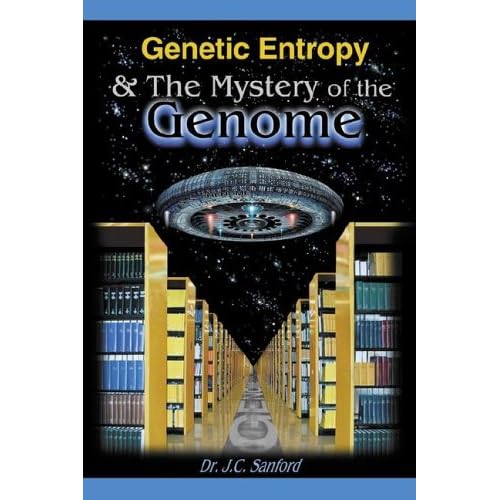
I was inspired to write this entry, mainly as a reminder to myself for future reference, when I learned, yesterday, that a plant geneticist, Dr John C Sanford, wrote a book titled Genetic Entropy & the Mystery of the Genome in which he probably abuses the concept of entropy in order to draw conclusions about his own field: "This book strongly refutes the Darwinian concept that man is just the result of a random and pointless natural process." The sentence, appearing in the book's description is wrong: the Darwinian process is not just random and cannot be described, merely, as a random process. (I also say "probably abuses" because I have not read the book yet.) I'd be interested to see if Jeff Shallit has spotted this, as he often likes to comment on the abuse of Information Theory by Creationists/Intelligent designers.

People transgress boundaries all the time, especially in Academia, and, often, for good reasons. In fact, I am a big supporter of cross-disciplinary research. However, it is not enough to merely have a haphazard knowledge of a secondary field: experience and knowledge are necessary. Otherwise, funny things can happen. Just as the Sanford example I mentioned above. Let me mention a few more:

The domain of biologically-inspired computing: Although I don't condemn the field, there are many silly papers written all the time. Here is one, published in the IEEE Transactions of Evolutionary Computation. This paper says the following, literally: If you have 1 million grains of sand numbered 1, 2, up to 1 million, one of which is red, but you don't know which is red, then there is no algorithm that will perform better than blind search; that is, choose a grain at random, look at the colour, and keep doing it until you find the red one. This theorem, now known as the No Free-Lunch Theorem (NFLT) is proved in a convoluted (and silly) manner in the paper. Many papers of this sort are produced (daily?) by Computer Scientists, Mathematicians and Engineers who decided to use Biological language in their research (without, perhaps, understanding this discipline).

The mathematically-inspired research on religion: Religion, per se, is, of course, not an academic discipline (or should not be), just as Astrology is not. (The study of the religious phenomenon, as a social phenomenon, on the contrary, is an academic discipline, just as the study of mental diseases is.) However, there are many researchers and "researchers" in Academia who have decided to use Mathematics to prove that their religion is correct. I'm saying it bluntly, but it is so even if they pretend to be arguing only about the existence of a deity or about design in the universe. Ultimately, they are only arguing from their own religious viewpoint. Two examples here: William Dembski, Professor of Theology and Science at the Southwestern Baptist Theological Seminary, ex-mathematician, is constantly abusing his prior field, Mathematics, in order to promote the so-called Intelligent Design (ID) ideas, which are versions of the so-called Creationism. In his Jesus Tomb Math paper is not the worst example. But his papers where he "uses" Information Theory for ID purposes are a good laugh. Second example is John Lennox, Professor of Algebra at the more reputable University of Oxford. He is a mathematician and a priest and uses mathematics to "prove" that god exists. I've written about him before.

The physico- mathematically-inspired research on post-modern philosophy is another case, beautifully exposed by Alan Sokal. In his paper, "Transgressing the Boundaries: Towards a Transformative Hermeneutics of Quantum Gravity", he exposes the idiocies of post-modernism, by writing a paper on this field, a paper which he managed to publish! Irene Irigaray is one of the post-modern philosophers who, among other things, argues that equations in Physics are predominantly male.

Examples of this sort abound. I can think of some more. I would be interested in discovering the ones I am not aware of.

11 November 2009

Criticising Khamenei

Defying all conventions, a young mathematics student in Iran, Mahmoud Vahidnia, stood up and openly criticised Khamenei, talked about lack of freedom in Iran and lack of freedom of speech. His talk lasted 20 minutes. The official claim is that he is not arrested but, of course, we do not know for sure.

In a rational world, everybody and everything should be subject to criticism, questioning and doubt. There is no democracy without rationality. And this is true at all levels. At the moment we feel fear of raising a question we (should) know that something is wrong; and we should have the courage to admit so, at least to ourselves. Unfortunately, most will suppress their very thoughts and even subject themselves to self-brain-washing: this is the most comfortable approach.

9 November 2009

Professors in the UK are required to act as police agents, Part II

Earlier this autumn, I wrote a post explaining how we, professors, are requirted to monitor students with visas and report back to the university who will report to the UK Border Agency. Another bureaucratic rule established means one more opportunity for the administrator to rejoice and one less opportunity for those of us who would like to engage in actual education and research, rather than bureaucratic meetings.

Rules, rules, and more rules is what will bring the university down.

But let's momentarily have a laugh about the whole thing by looking at some cartoons:
Part 1
Part 2
Part 3

What bothers me is not the rules themselves, neither the people who establish them. This is their job. They have to justify their salary, invent something, keep the wheels rolling. What bothers me is that nobody in the academic establishment talks about this. It is as if anything goes. Which raises the question: What if we lived in a dictatorship? Would everybody keep their mouths equally shut? (I'm afraid, yes...)

P.S. Thanks to Michael Fridman for the cartoon references.


T H E B O T T O M L I N E

What measure theory is about

It's about counting, but when things get too large.
Put otherwise, it's about addition of positive numbers, but when these numbers are far too many.

The principle of dynamic programming

max_{x,y} [f(x) + g(x,y)] = max_x [f(x) + max_y g(x,y)]

The bottom line

Nuestras horas son minutos cuando esperamos saber y siglos cuando sabemos lo que se puede aprender.
(Our hours are minutes when we wait to learn and centuries when we know what is to be learnt.) --António Machado

Αγεωμέτρητος μηδείς εισίτω.
(Those who do not know geometry may not enter.) --Plato

Sapere Aude! Habe Muth, dich deines eigenen Verstandes zu bedienen!
(Dare to know! Have courage to use your own reason!) --Kant