
28 November 2008


26 November 2008
God Trumps: a family card game
Christmas is in the air. You walk down high street and you are bombarded with all kinds of festive songs, ranging from Rudolph the Red-Nose Reindeer to God Rest Ye Merry Gentlemen and the like. Like it or not, you are bound to hear the same music hundreds of times. It is, after all, the festive season, the season to spend your money, and the music, according to marketing researches, helps you do that. Christmas lasts now about two months each year (1/6 of the year). Christmas needs Gemütlichkeit, everyone around the fireplace (regardless of the temperature outside), and Glühwein, and food and, of course, family games! One of the best games around this season is God Trumps, invented by the New Humanist. It is designed to help the whole family choose the right religion. It's a card game. To play it, print the cards at size 63 mm × 88 mm (or B8 size) and glue on old playing cards or cardboard. (Some family activity too!) The rules are extremely simple and need not be added here for fear of insulting your intelligence.

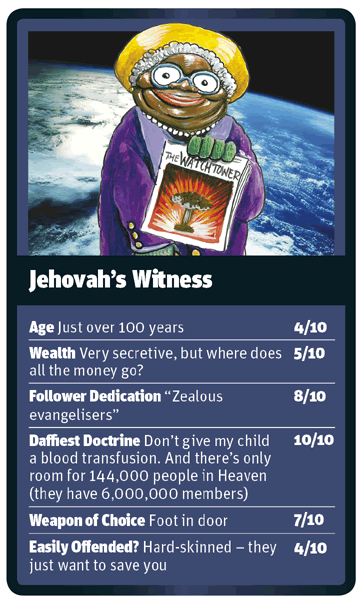
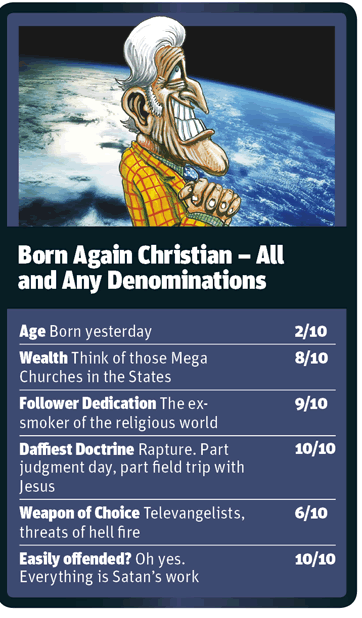

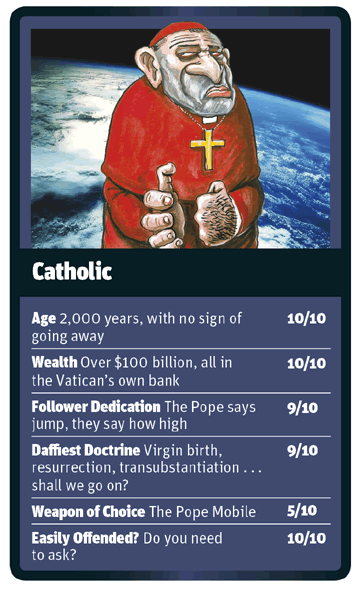
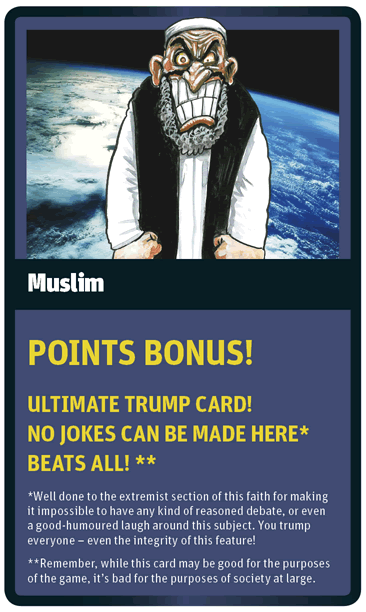

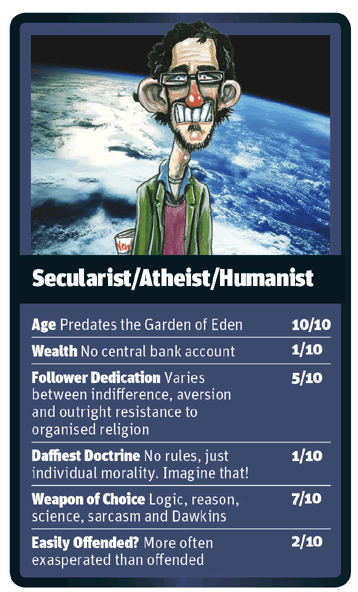
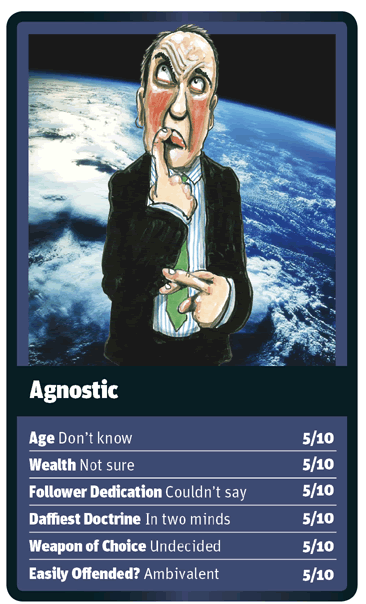

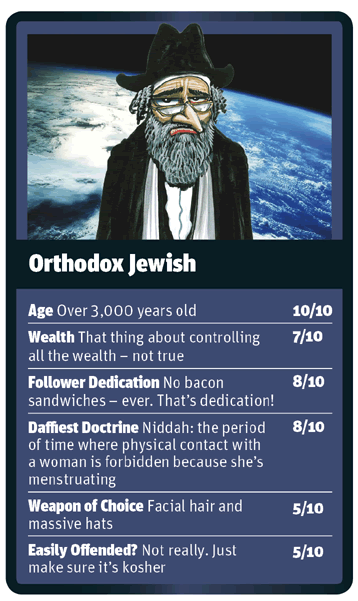
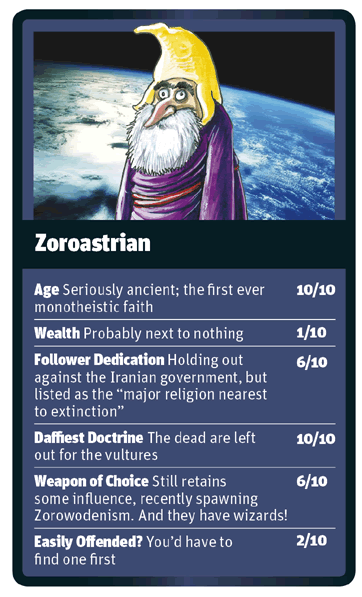
As an added twist to the game, you may:
(i) Add your own religion. Who knows? You may be a success! And why not? A religion is something that can be invented and changed. The concept of a time-varying religion should seriously be studied in institutions of higher learning hosting schools of theology or divinity.
(ii) Copy the cards many times. Have a stock of dozens of each one and, depending on the way the game goes, see which cards are become dominant. Perhaps this will be an indication of the new cool religionof the year.
(iii) Invite your neighbours. Get involved in outreach activities. Play with your friends, make sure the game is spread all over the town, the country, the world!
(iv) Write to Tony Blair and ask him to adopt it as part of his course at Yale.
As an added twist to the game, you may:
(i) Add your own religion. Who knows? You may be a success! And why not? A religion is something that can be invented and changed. The concept of a time-varying religion should seriously be studied in institutions of higher learning hosting schools of theology or divinity.
(ii) Copy the cards many times. Have a stock of dozens of each one and, depending on the way the game goes, see which cards are become dominant. Perhaps this will be an indication of the new cool religionof the year.
(iii) Invite your neighbours. Get involved in outreach activities. Play with your friends, make sure the game is spread all over the town, the country, the world!
(iv) Write to Tony Blair and ask him to adopt it as part of his course at Yale.
23 November 2008
Deep faith
This is a video about praying in unison. No comments will be added. Just watch and see what Goya meant when he said "the sleep of reason creates monsters". This is what faith is about, and what you see here is not an isolated phenomenon. Alas, there are far too many men and women of faith who practice these things. I wonder what Blair thinks about them when he teaches faith at Yale University...
21 November 2008
No to Guantánamo, Yes to Guantanamera

“As President, I will
close Guantánamo,
reject the Military Commissions Act, and adhere to the Geneva Conventions”
– Barack Obama, 8/1/07
Therefore, now that he is president, we ask him: Close Guantánamo and end military commissions. In fact, let Guantánamo be a place where guantanamera comes from; it is songs we need, no war, no torture, no hatred:
18 November 2008
Silly maths quiz at BBC site
Marcus du Sautoy, the man who will succeed Richard Dawkins as professor for the understanding of science at the University of Oxford, has a mission to break down people's fear of maths. So he set up a quiz. Unfortunately, the quiz is rather naive and does not reflect what mathematics is about. Here are some dubious questions:
* A temple was built in 50 BC and burnt down 75 years later. In what year whas it burnt down?
(1) 24 AD. (2) 25 AD. (3) 26 AD.
The logical thinking gives -50+75=+25, i.e. 25 AD (provided that both events took place on the same day of the year, say on day 1.)
But the answer given by the BBC is: 26 AD. There was no year 0.
This is a fact, indeed: that there was no year 0. Some 1500 years ago, a monk called Dionisius Exiguus was charged with the creation of a calendar; this monk did not know that the integer succeeding -1 is 0 and not +1; i.e. he thought that -1+1=1.
But the ignorance of a monk should not be brought into a mathematical quiz which, supposedly, tests one's understanding of logic (and not of history!)
* Imagine picking up a cube with your thumb placed at one corner of the cube and your finger at the furthest corner on the other side of the cube. Now cut the cube exactly down the middle between your finger and thumb. You have two pieces with a new face. What is the shape of the new face?
(1) Hexagonal. (2) Square. (3) Triangular.
Before looking at the answer let us look at the way the problem is phrased. First, what exactly is meant by a corner? Is it a vertex? Is it an edge? I think he means a vertex, i.e. the point at which 3 faces meet. But it could be an edge: the segment at which 2 faces meet forms a corner, in my humble opinion, too. The answer will of course, be different depending on the interpretation of the word corner. OK, let us assume he means a vertex. Now what does he mean by "cut the cube exactly down the middle"? This could also mean a number of things. Here we must guess that he means to take the plane that is perpendicular to the segment joining two vertices at farthest distant appart and which passes through the middlepoint of this segment. This plane intersects the (boundary of the) cube at a polygon. And this polygon is, indeed, a hexagon.
But a mathematical question should be phrased in an unambiguous way!
* What is the next number in the sequence 1001, 122, 101, 32, 25, 23, 21, ...
(1) 20. (2) 18. (3) 15.
Again, this is a dangerous question for the mathematically uninitiated for he or she may think that there is a unique choice. For instance, if I give you the sequence 1,4,8,16,32,64,128 you might think that the next number is 256 (powers of 2). But a perfectly acceptable answer is 144. (Indeed, if we let p(m) be the product of the exponents in the prime factorisation of m, and define q(n) to be to be the smallest integer such that p(q(n))=n then q(1)=1, q(2)=4,...,q(7)=128, but q(8)=144.)
Now then, the answer to this question, according to BBC, but also according to the encyclopedia of integer sequences, is 18: if we write the number 17 in base 2 we get 1001, in base 3 it is 122, and so on.
But hang on a minute! This is by far NOT a fair question and a misleading one for the two reasons I outlined: first, it gives the wrong impession on what Mathematics is about. Second, the answer is hard and, clearly, not unique.
* A temple was built in 50 BC and burnt down 75 years later. In what year whas it burnt down?
(1) 24 AD. (2) 25 AD. (3) 26 AD.
The logical thinking gives -50+75=+25, i.e. 25 AD (provided that both events took place on the same day of the year, say on day 1.)
But the answer given by the BBC is: 26 AD. There was no year 0.
This is a fact, indeed: that there was no year 0. Some 1500 years ago, a monk called Dionisius Exiguus was charged with the creation of a calendar; this monk did not know that the integer succeeding -1 is 0 and not +1; i.e. he thought that -1+1=1.
But the ignorance of a monk should not be brought into a mathematical quiz which, supposedly, tests one's understanding of logic (and not of history!)
* Imagine picking up a cube with your thumb placed at one corner of the cube and your finger at the furthest corner on the other side of the cube. Now cut the cube exactly down the middle between your finger and thumb. You have two pieces with a new face. What is the shape of the new face?
(1) Hexagonal. (2) Square. (3) Triangular.
Before looking at the answer let us look at the way the problem is phrased. First, what exactly is meant by a corner? Is it a vertex? Is it an edge? I think he means a vertex, i.e. the point at which 3 faces meet. But it could be an edge: the segment at which 2 faces meet forms a corner, in my humble opinion, too. The answer will of course, be different depending on the interpretation of the word corner. OK, let us assume he means a vertex. Now what does he mean by "cut the cube exactly down the middle"? This could also mean a number of things. Here we must guess that he means to take the plane that is perpendicular to the segment joining two vertices at farthest distant appart and which passes through the middlepoint of this segment. This plane intersects the (boundary of the) cube at a polygon. And this polygon is, indeed, a hexagon.
But a mathematical question should be phrased in an unambiguous way!
* What is the next number in the sequence 1001, 122, 101, 32, 25, 23, 21, ...
(1) 20. (2) 18. (3) 15.
Again, this is a dangerous question for the mathematically uninitiated for he or she may think that there is a unique choice. For instance, if I give you the sequence 1,4,8,16,32,64,128 you might think that the next number is 256 (powers of 2). But a perfectly acceptable answer is 144. (Indeed, if we let p(m) be the product of the exponents in the prime factorisation of m, and define q(n) to be to be the smallest integer such that p(q(n))=n then q(1)=1, q(2)=4,...,q(7)=128, but q(8)=144.)
Now then, the answer to this question, according to BBC, but also according to the encyclopedia of integer sequences, is 18: if we write the number 17 in base 2 we get 1001, in base 3 it is 122, and so on.
But hang on a minute! This is by far NOT a fair question and a misleading one for the two reasons I outlined: first, it gives the wrong impession on what Mathematics is about. Second, the answer is hard and, clearly, not unique.
Subscribe to:
Posts (Atom)


