I came across this physics paper by browsing the arXiv.org e-Print archive tonight. It is titled
"Readiness of the ATLAS Liquid Argon Calorimeter for LHC Collisions"
and has 2789 authors! Yes, that's right:
Two thousand seven hundred and eighty nine authors!
The papers is 31 pages long. Seven of these pages are devoted to the listing of the authors' names. Actually, all letters of the alphabet are there: there is at least one author whose family name starts with any given letter. It takes another 4 pages to list the authors' affiliations. One of the authors is marked as deceased at the time of submission of the paper. (Considering their number, this must be a not-so-unlikely event.)
I wish I knew whether this is a world record.
21 May 2010


12 May 2010
Don't talk to aliens
I'm spending a few months at Cambridge. I couldn't miss it therefore but be informed of the latest announcement of Professor Stephen Hawking, namely:

However, today, another fact became known to me which, surely, and beyond any doubt, provides the definitive explanation about aliens:
“To my mathematical brain, the numbers alone make thinking about aliens perfectly rational. The real challenge is to work out what aliens might actually be like.”
“We only have to look at ourselves to see how intelligent life might develop into something we wouldn’t want to meet. I imagine they might exist in massive ships, having used up all the resources from their home planet. Such advanced aliens would perhaps become nomads, looking to conquer and colonise whatever planets they can reach.”
“If aliens ever visit us, I think the outcome would be much as when Christopher Columbus first landed in America, which didn’t turn out very well for the Native Americans.”
However, today, another fact became known to me which, surely, and beyond any doubt, provides the definitive explanation about aliens:
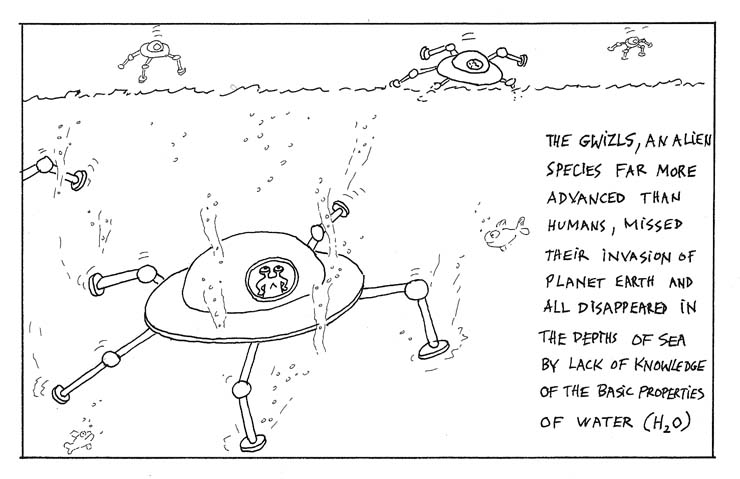
The Gwizls, an alien species far more advanced than humans, missed their invasion of planet Earth and all disappeared in the depths of sea by lack of knowledge of the basic properties of water (H2O)The announcement was made by Professor Pierre Brémaud (visiting fellow of the Newton Institute for Mathematical Sciences). Proof below:
As much as you can
TRANSLATION:
As Much As You Can
And if you can’t shape your life the way you want,
at least try as much as you can
not to degrade it
by too much contact with the world,
by too much activity and talk.
Try not to degrade it by dragging it along,
taking it around and exposing it so often
to the daily silliness
of social events and parties,
until it comes to seem a boring hanger-on.
at least try as much as you can
not to degrade it
by too much contact with the world,
by too much activity and talk.
Try not to degrade it by dragging it along,
taking it around and exposing it so often
to the daily silliness
of social events and parties,
until it comes to seem a boring hanger-on.
(C.P. Cavafy, Collected Poems. Translated by Edmund Keeley and Philip Sherrard. Edited by George Savidis. Revised Edition. Princeton University Press, 1992)
For another translation in English, by Charles Bryant, click here.
10 May 2010
What is Enlightenment?
The motto of the Enlightenment is not a thing of the past. It is modern and will always be so:
The message of the Enlightenment should be read and understood by all, even people working in the Academia (teachers and administrators alike).
Here is the original first page from Imanuel Kant's essay "Beantwortung der Frage: Was ist Aufklärung? -- Berlinische Monatsschrift, Bd. 4, 481-494, 1784".
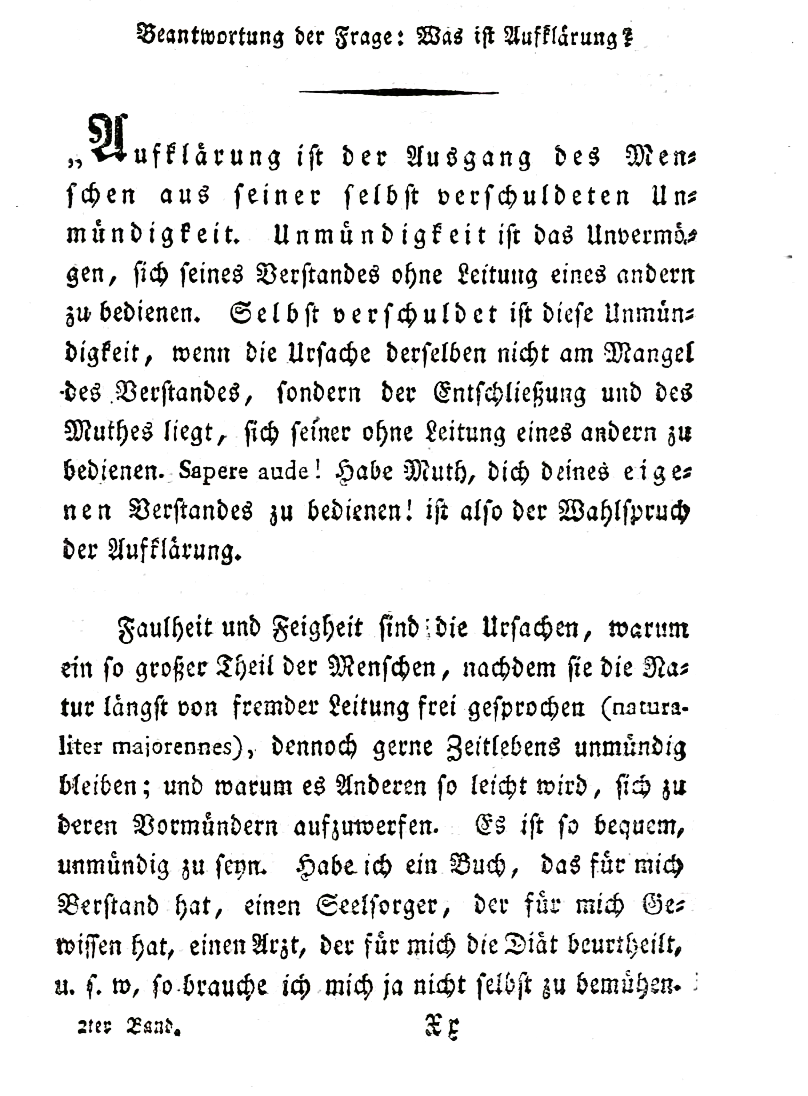
Aufklärung ist der Ausgang des Menschen aus seiner selbst verschuldeten Unmündigkeit. Unmündigkeit ist das Unvermögen, sich seines Verstandes ohne Leitung eines anderen zu bedienen. Selbstverschuldet ist diese Unmündigkeit, wenn die Ursache derselben nicht am Mangel des Verstandes, sondern der Entschließung und des Muthes liegt, sich seiner ohne Leitung eines anderen zu bedienen. Sapere Aude! Habe Muth dich deines eigenen Verstandes zu bedienen! ist also der Wahlspruch der Aufklärung.
Enlightenment is man's release from his self-incurred tutelage. Tutelage is man's inability to make use of his understanding without direction from another. Self-incurred is this tutelage when its cause lies not in lack of reason but in lack of resolution and courage to use it without direction from another. Sapere aude! "Have courage to use your own reason!" - that is the motto of enlightenment.So the message of the Enlightenment is not, simply, the lack of reason but the lack of ability to use one's reason. Reasoning independently and with courage is what the motto of the enlightenment is. "Sapere aude" means "dare to know" and, by extension, dare to use your own reason, independently, without the guidance of somebody else, free of external influences even (or, perhaps, especially) when these influences are part of an established "tradition".
The message of the Enlightenment should be read and understood by all, even people working in the Academia (teachers and administrators alike).
Here is the original first page from Imanuel Kant's essay "Beantwortung der Frage: Was ist Aufklärung? -- Berlinische Monatsschrift, Bd. 4, 481-494, 1784".
6 May 2010
Neanderthal genes 'survive in us'
A fascinating report:
Many people alive today possess some Neanderthal ancestry, according to a landmark scientific study.
The finding has surprised many experts, as previous genetic evidence suggested the Neanderthals made little or no contribution to our inheritance.
The result comes from analysis of the Neanderthal genome - the "instruction manual" describing how these ancient humans were put together.
The genomes of 1% to 4% of people in Eurasia come from Neanderthals.
But the study confirms living humans overwhelmingly trace their ancestry to a small population of Africans who later spread out across the world.
The most widely-accepted theory of modern human origins - known as Out of Africa - holds that the ancestors of living humans (Homo sapiens) originated in Africa some 200,000 years ago.
A relatively small group of people then left the continent to populate the rest of the world between 50,000 and 60,000 years ago.
While the Neanderthal genetic contribution - found in people from Europe, Asia and Oceania - appears to be small, this figure is higher than previous genetic analyses have suggested.
"They are not totally extinct. In some of us they live on, a little bit," said Professor Svante Paabo, from the Max Planck Institute for Evolutionary Anthropology in Leipzig, Germany.
Professor Chris Stringer, research leader in human origins at London's Natural History Museum, is one of the architects of the Out of Africa theory. He told BBC News: "In some ways [the study] confirms what we already knew, in that the Neanderthals look like a separate line.
"But, of course, the really surprising thing for many of us is the implication that there has been some interbreeding between Neanderthals and modern humans in the past."
John Hawks, assistant professor of anthropology at the University of Wisconsin-Madison in the US, told BBC News: "They're us. We're them.
"It seemed like it was likely to be possible, but I am surprised by the amount. I really was not expecting it to be as high as 4%," he said of the genetic contribution from Neanderthals.
The sequencing of the Neanderthal genome is a landmark scientific achievement, the product of a four-year-long effort led from Germany's Max Planck Institute but involving many other universities around the world.
The project makes use of efficient "high-throughput" technology which allows many genetic sequences to be processed at the same time.
The draft Neanderthal sequence contains DNA extracted from the bones of three different Neanderthals found at Vindija Cave in Croatia.
Retrieving good quality genetic material from remains tens of thousands of years old presented many hurdles which had to be overcome.
The samples almost always contained only a small amount of Neanderthal DNA amid vast quantities of DNA from bacteria and fungi that colonised the remains after death.
The Neanderthal DNA itself had broken down into very short segments and had changed chemically. Luckily, the chemical changes were of a regular nature, allowing the researchers to write software that corrected for them.
Writing in Science journal, the researchers describe how they compared this draft sequence with the genomes of modern people from around the globe.
"The comparison of these two genetic sequences enables us to find out where our genome differs from that of our closest relative," said Professor Paabo.
The results show that the genomes of non-Africans (from Europe, China and New Guinea) are closer to the Neanderthal sequence than are those from Africa.
The most likely explanation, say the researchers, is that there was limited mating, or "gene flow", between Neanderthals and the ancestors of present-day Eurasians.
This must have taken place just as people were leaving Africa, while they were still part of one pioneering population. This mixing could have taken place either in North Africa, the Levant or the Arabian Peninsula, say the researchers.
The Out of Africa theory contends that modern humans replaced local "archaic" populations like the Neanderthals.
But there are several variations on this idea. The most conservative model proposes that this replacement took place with no interbreeding between modern humans and Neanderthals.
Another version allows for a degree of assimilation, or absorption, of other human types into the Homo sapiens gene pool.
The latest research strongly supports the Out of Africa theory, but it falsifies the most conservative version of events.
The team also identified more than 70 gene changes that were unique to modern humans. These genes are implicated in physiology, the development of the brain, skin and bone.
The researchers also looked for signs of "selective sweeps" - strong natural selection acting to boost traits in modern humans. They found 212 regions where positive selection may have been taking place.
The scientists are interested in discovering genes that distinguish modern humans from Neanderthals because they may have given our evolutionary line certain advantages over the course of evolution.
The most obvious differences were in physique: the muscular, stocky frames of Neanderthals contrast sharply with those of our ancestors. But it is likely there were also more subtle differences, in behaviour, for example.
Dr Hawks commented that the amount of Neanderthal DNA in our genomes seemed high: "What it means is that any traits [Neanderthals] had that might have been useful in later populations should still be here.
"So when we see that their anatomies are gone, this isn't just chance. Those things that made the Neanderthals apparent to us as a population - those things didn't work. They're gone because they didn't work in the context of our population."
Researchers had previously thought Europe was the region where Neanderthals and modern humans were most likely to have exchanged genes. The two human types overlapped here for some 10,000 years.
The authors of the paper in Science do not rule out some interbreeding in Europe, but say it was not possible to detect this with present scientific methods.
Subscribe to:
Posts (Atom)


