Showing posts with label rationality. Show all posts
6 May 2014
25 May 2013
The gender of god
It's been long time since I posted anything, but time is scarce. Today, however, I was motivated by the silly response of someone identifying herself as Shirley J. Schultz in this posting from Sabio Lantz's Triangulations. She kept talking about god as if god were male:
I raised this issue with muslims several times. Allah is gender-less, they respond. Fine then, I'll call Allah a "she". No, they reply. This is blasphemy.
Why can’t religious people see the irrationality of attaching a male pronoun (and, therefore, a gender) to god? Let us consider the following two statements:
My fault, however, is that I tend to think that all people are rational. This is wrong. I devised the follloing hypothetical dialogue with Shirley J. Schultz:
Shirley: God does not have gender. He is above human nature.
Takis: But you keep using “he”.
Shirley: Well, this is just a convention.
Takis: OK, I understand. So it’s fine if I say “God’s works reveal her glory”.
Shirley: No, you can’t say that.
Takis: Why not?
Shirley: It’s a blasphemy.
Takis: But you told me god does not have gender.
Shirley: Yes, but the bible says “he”.
Takis: Was the bible written by god?
Shirley: Yes, of course!
Takis: Then god tells us god prefers to be addressed by the male pronoun.
Shirley: This is not important. He does not have gender.
Takis: OK, may I then refer to god as “it”? Like: “God’s works reveal its glory”.
Shirley: You may not (emphatically) call god “it”. God is not a thing!
Takis: I didn’t say so, I was just trying to avoid assigning a gender to god. So, if “it” is not allowed, I will use “she”.
Shirley: No, you can’t do that.
Takis: Why not?
Shirley: It’s a blasphemy.
Takis: But you told me god does not have gender.
etc.
etc.
There is absolutely no way to get the argument resolved, because Shirley has no way to defend her position. She is falling into a contradiction. On one hand god has no gender, but on the other we are being told god likes to be called a “he”. So, even if god has no gender, god prefers the male pronoun.
A second version of the dialogue (I won’t bother writing it down) could start by Shirley supporting the idea that man is created in the image of god, so god has a gender. Now, why god has male gender is baffling, and Shirley won’t be able to defend the simple observation that this implies that god gives preference to men.
In either case, Shirley has no rational argument and/or will reach a contradiction. But such is the religious mind. It is not disturbed by the irrational even when the irrational is obvious. The religious mind would rather hurt itself or hurt other but would never admit violation of (elementary) logic.
Sabio gave me a response. He thinks that Shirley would have responded in this way:
P.S. Soon I hope to post another article, related to gender issues which are very important in Sweden. As I pointed out before, they even have a government department dealing with these issues. A few months ago, I attended a couple of lectures on gender issues, and, in particular, on issues regarding women's under-represented positions, and asked the question whether they have ever considered the role of religion in connection with this. Surprisingly, the speaker didn't have a clue and hadn't even thought about it, apparently. More on this in a future post.
... you also keep calling God “your God”. There is only one God. Different cultures call Him by different names. He is your God, too...I don't understand why religious people (muslims, christians, jews, and others) don't ever wonder why they refer to god using the masculine personal personal pronouns "he", "him" and "his". Is it because they think god is male?
I raised this issue with muslims several times. Allah is gender-less, they respond. Fine then, I'll call Allah a "she". No, they reply. This is blasphemy.
Why can’t religious people see the irrationality of attaching a male pronoun (and, therefore, a gender) to god? Let us consider the following two statements:
- It is a fact that god has (male) gender because the scriptures tell us so and we may not refute the scriptures.
- God has male gender because the concept was created by people in patriarchal societies.
My fault, however, is that I tend to think that all people are rational. This is wrong. I devised the follloing hypothetical dialogue with Shirley J. Schultz:
Shirley: God does not have gender. He is above human nature.
Takis: But you keep using “he”.
Shirley: Well, this is just a convention.
Takis: OK, I understand. So it’s fine if I say “God’s works reveal her glory”.
Shirley: No, you can’t say that.
Takis: Why not?
Shirley: It’s a blasphemy.
Takis: But you told me god does not have gender.
Shirley: Yes, but the bible says “he”.
Takis: Was the bible written by god?
Shirley: Yes, of course!
Takis: Then god tells us god prefers to be addressed by the male pronoun.
Shirley: This is not important. He does not have gender.
Takis: OK, may I then refer to god as “it”? Like: “God’s works reveal its glory”.
Shirley: You may not (emphatically) call god “it”. God is not a thing!
Takis: I didn’t say so, I was just trying to avoid assigning a gender to god. So, if “it” is not allowed, I will use “she”.
Shirley: No, you can’t do that.
Takis: Why not?
Shirley: It’s a blasphemy.
Takis: But you told me god does not have gender.
etc.
etc.
There is absolutely no way to get the argument resolved, because Shirley has no way to defend her position. She is falling into a contradiction. On one hand god has no gender, but on the other we are being told god likes to be called a “he”. So, even if god has no gender, god prefers the male pronoun.
A second version of the dialogue (I won’t bother writing it down) could start by Shirley supporting the idea that man is created in the image of god, so god has a gender. Now, why god has male gender is baffling, and Shirley won’t be able to defend the simple observation that this implies that god gives preference to men.
In either case, Shirley has no rational argument and/or will reach a contradiction. But such is the religious mind. It is not disturbed by the irrational even when the irrational is obvious. The religious mind would rather hurt itself or hurt other but would never admit violation of (elementary) logic.
Sabio gave me a response. He thinks that Shirley would have responded in this way:
“Jehovah, the one true God, has always been spoken of a as a masculine entity. God is certainly above our understanding, and this use of a masculine pronoun should not narrow our thinking, but it is the closest pronoun to describing God than any other. To assume God is anything like your common notions of the word “he” just illustrates how dimly you see into the nature of God. He is there for you, Takis, be open to his spirit and language will stop becoming an obstacle between you and God.”And continued, thus:
Shirley could have mustered together a fairly intelligent response, or she could have fumbled and given a totally contradictory rambling. But if you think you are going to trap her and it will change her, you may be wrong if she is more highly vested in her commitment than to a temporary argument. Even if you frustrate her argument, she will come back with some trite platitude and tell you how you must come to worship the one true God.He is right. I still, however, would love a rational response about god's gender from Shirley J. Schultz or other religious people.
P.S. Soon I hope to post another article, related to gender issues which are very important in Sweden. As I pointed out before, they even have a government department dealing with these issues. A few months ago, I attended a couple of lectures on gender issues, and, in particular, on issues regarding women's under-represented positions, and asked the question whether they have ever considered the role of religion in connection with this. Surprisingly, the speaker didn't have a clue and hadn't even thought about it, apparently. More on this in a future post.
26 November 2012
Bertrand Russell's message to future generations
— What would you think it’s worth telling future generations about the life you’ve lived and the lessons you’ve learned from it?
“I should like to say two things, one intellectual and one moral. The intellectual thing I should want to say is this: When you are studying any matter, or considering any philosophy, ask yourself only what are the facts and what is the truth that the facts bear out. Never let yourself be diverted either by what you wish to believe, or by what you think would have beneficent social effects if it were believed. But look only, and solely, at what are the facts. That is the intellectual thing that I should wish to say.
The moral thing I should wish to say… I should say love is wise, hatred is foolish. In this world which is getting more closely and closely interconnected we have to learn to tolerate each other, we have to learn to put up with the fact that some people say things that we don’t like. We can only live together in that way and if we are to live together and not die together we must learn a kind of charity and a kind of tolerance which is absolutely vital to the continuation of human life on this planet.”
Bertrand Russell, 1959
5 August 2012
George Pell: more blunders
In my previous posting I pointed out that, in the Dawkins-Pell Q&A session, George Pell thought that non-randomness is equivalent to "having a purpose". Here are some more of his blunders. He claimed that:
The discussion was full of such gems. It's a video worth watching. I'll leave it at that. If you spot more blunders, let me know.
- Humans evolved from Neanderthals. When Dawkins pointed out to him that this is not correct, because Neanderthals are more like our cousins, Pell defended his position by saying that this cannot be true because he does not see any Neanderthals around. Then Dawkins told him they are extinct.
- Jews were not intellectually equal of the Egyptians and Persians. He also said that Jews were shepherds, stuck between great powers, and are still stuck. Here, Pell confuses the term "intellectual" and "great power". He seems to be implying that, because the Persians had a mighty empire, that automatically implies that they were the intellectuals of the day too.
- Germans [during or after WWII] suffered more than the Jews [during the Holocaust]. Pell mentioned this as a response to a question on suffering. Yes, Jews suffered, but god arranged so that Germans suffered too, he, more or less said, just as much. (He subsequently issued a statement clarifying his comments and insisting he did not intend to offend the Jewish community.)
- During holy communion, the wafer and the wine turns, literally, into the body and blood of Christ. So that whoever received holy communion actually consumes flesh and blood. I know this is a cliche among Catholics, they actually believe that, but it is funny to hear it from an "authority". His explanation for this miracle is: Jesus said so. (End of story. Quod Erat Demonstrandum.)
- Science cannot give us the reason why we are here. Correct. But he does not understand that this is a silly statement. Why should there be a reason in the first place? (See previous posting on Lennox too.) Equivalent statements are the following: Astronomy cannot give us the reason for the existence of rings of Saturn. No, George, science is not so petty to deal with this. Science will give you the process for the formation of the rings, not their teleological property which, after all, is a product of projection of human behaviour to nature.
- One of our problems is that we don't understand why suffering exists, but it is a much greater problem for atheists to explain why there is goodness and truth and beauty. This is related to the last one.
The discussion was full of such gems. It's a video worth watching. I'll leave it at that. If you spot more blunders, let me know.
Cardinal Pell: "Could you explain what non-random means?"
In April 2012, the Australian TV hosted a Q&A session with Richard Dawkins and George Pell (Catholic Cardinal of Australia) as respondents. I watched the 1-hour programme on youtube. I recommend it, as an exercise to spotting a large number of rational mistakes by Pell. The most interesting misconception of Pell is that he does not understand the term "random". This is a serious mistake, because he has been all along thinking been basing his belief system on the following:
Ok, so Pell has had a misunderstanding of what evolution is about. But this is not his most serious mistake. After all, he claims, that a Catholic may believe in evolution if he or she likes. (Notice how he uses the verb "believe", as if there is a choice to believe or not a scientific fact; for instance, I have no choice in believing that gravitational force varies in inverse proportion of the square of the distance between two bodies, because it is so--period; whether I like it or not.)
His most serious mistake, which can (and I'm surely does) affect all his belief system is that he thinks that non-random is equivalent to having a purpose. It is so simple to realise the falsity of this, that it is painful to have to explain it, so I will leave it as an (easy) exercise. Pell makes this mistake because he badly wants to justify his views, so badly that he alters the meaning of things. Assigning purpose to concepts (such as "randomness") and to natural things (such as "the Earth") is an attempt to anthropomorphize Nature and the kind of Language we use to understand Nature. "God is created in Man's image" is what Pell's belief system is all about, and, therefore, he seems to believe that everything behaves in the same way that humans behave. The purpose found in human actions cannot be transferred to natural objects and concepts (teleology).
Not only the formula "non-random = having a purpose" is wrong because one can show that the two sides are unequal, but it is one which, simply, cannot be written down, like one cannot write down the formula "2+5 = the Moon's beauty".
A similar fallacy can be seen in John Lennox's Pie Argument, of which I'll say something next.
non-random =[equivalent to] having a purposeAnd, therefore, that
random =[equivalent to] not having a purposeI'll leave aside whether one can always be asking about purpose, and proceed in seeing, exactly, how the Cardinal reveals his inadequacy, clearly and wittingly. He starts by saying that religion is not science (correct) but people can use reason in religion, that they can they have, for example, to reason about the parts of science regarding evolution.The excerpt of the dialogue goes like this:
- Pell: People have to ask whether they believe that random selection is sufficient. Most evolutionary biologists don't believe in this crude fundamentalist version of random selection that you propose.
- Dawkins: I do not propose it. I strongly deny that evolution is random selection. It is non-random selection.
- P: Oh, so there's a purpose to it?
- D: No.
- P: Could you explain what non-random means?
Ok, so Pell has had a misunderstanding of what evolution is about. But this is not his most serious mistake. After all, he claims, that a Catholic may believe in evolution if he or she likes. (Notice how he uses the verb "believe", as if there is a choice to believe or not a scientific fact; for instance, I have no choice in believing that gravitational force varies in inverse proportion of the square of the distance between two bodies, because it is so--period; whether I like it or not.)
His most serious mistake, which can (and I'm surely does) affect all his belief system is that he thinks that non-random is equivalent to having a purpose. It is so simple to realise the falsity of this, that it is painful to have to explain it, so I will leave it as an (easy) exercise. Pell makes this mistake because he badly wants to justify his views, so badly that he alters the meaning of things. Assigning purpose to concepts (such as "randomness") and to natural things (such as "the Earth") is an attempt to anthropomorphize Nature and the kind of Language we use to understand Nature. "God is created in Man's image" is what Pell's belief system is all about, and, therefore, he seems to believe that everything behaves in the same way that humans behave. The purpose found in human actions cannot be transferred to natural objects and concepts (teleology).
Not only the formula "non-random = having a purpose" is wrong because one can show that the two sides are unequal, but it is one which, simply, cannot be written down, like one cannot write down the formula "2+5 = the Moon's beauty".
A similar fallacy can be seen in John Lennox's Pie Argument, of which I'll say something next.

38':25''--39':30'' COULD YOU EXPLAIN WHAT NON-RANDOM MEANS?
9 May 2012
Obsession with gender
This blog is about rationality. So, when I spot things which are irrational, I write about them. Indeed, an offence to one's sense of logic should be one of scientists' concerns.
In my less-than-two-years sojourn in Sweden, I noticed that there is a certain obsession with the concept of gender. Much in the same way that there was (and still is) obsession with affirmative action in the U.S. So, much so, that the obsession often violates elementary logic.
I pointed out some of these gender-type of obsessions before. For example, here and here. Of course, there is nothing wrong about promoting equality, at all levels, for all people, all genders, all ethnicities. But to be obsessed about it so much so that you feel the need to theorize that "one's sex is not biologically determined but rather something that is `socially constructed'" is a mere insult to elementary science and elementary logic. True, there are exceptions (as always) to the rule. There are people who may not feel comfortable with the gender they are born with and seek a change at some point in their lives. One should respect this. However, to say that everyone's gender is a social construct is not just absurd, but also idiotic.
Such things are pointed out in an article by Bo Rothstein, professor of Political Science at Gothenburg University. Rothstein refers to the Secretariat for Gender Research (sekretariat för genusforskning), formed several years ago, by the Swedish State. Again, having a body of the government interested in promoting equality of sexes, making sure that neither men are discriminated by women nor women by men, is laudable. But to have statements such as "analyze the need for gender research in all disciplines" is strange. I do not understand the meaning of the phrase. It is, to say the least, strange. It does not say "make sure that there is no sex discrimination in any job". The phrase above presupposes that there is a need for gender research in all scientific disciplines (analysera behovet av genusforskning inom alla vetenskapsområden). It is not unlikely that my Swedish (thanks to Google translate, to be honest) is not good enough, but "vetenskapsområden" means "scientific areas" (vetenskap = Wissenschaft = science). If, then, Physics is a scientific discipline, the phrase above implies that there is a need for gender research in Physics. Since it is true that Physics is a scientific discipline, we conclude that the sekretariat för genusforskning mandates that Physics should also be concerned with gender research. Now, this starts looking very irrational, doesn't it?
Pseudo-scientists who conduct gender research in Physics include a certain infamous philosopher, Luce Irigaray, who, among other things, argues that E=mc2 is a "sexed equation" because "it privileges the speed of light over other speeds that are vitally necessary to us". She also concludes that fluid mechanics is a neglected discipline because it deals with fluids (duh!) which are feminine in contrast to rigid mechanics which are masculine. For more information on this kind of idiotic research, please take a look at the book "Fashionable Nonsense" by Alan Sokal and Jean Bricmont.
Perhaps the Secretariat for Gender Research do not really mean to be irrational. Perhaps the phrase above, taken from their Code of Statutes, means something else. (We should always give someone the benefit of the doubt.) But then it is a mystery what they might mean, if they don't really mean Irigaray-type of pseudo-research.
Last but not least, when we talk about under-represented gender, we may as well remember that such things are, unfortunately, so much embedded in people's minds that people (even the ones who promote gender equality) cannot think of the root of the problem. Rather, they touch upon these problems tangentially, on the surface. As an example, take, for instance, the four monotheistic religions (Zoroastrinism, Judaism, Christianity and Islam, in chronological order of their foundation). As soon as homo sapiens came up with the idea that there is one god, this god immediately assumed male gender. (Whether this has something to do with a male-dominated society, I'll leave it as an exercise.) Therefore, if the Secretariat for Gender Research want to do something about equality, they should go to the Swedish Church (for instance) and tell them to change, or eliminate, the gender of their deity. At least this is more rational than looking for gender research in Physics. I'm willing to bet, however, that they won't do it.
Labels:
politics,
pseudo-science,
rationality,
religion,
Sweden
22 April 2012
On teaching
From time to time, I write some thoughts about education issues. Not because I'm a great pedagogue, neither because I think I have the best solution to the problem. (Not even because I think that students are bad. Such cliches are just pointing towards an easy way out of the door. In fact, us, teachers are more responsible than students.) But only because, nowadays, and in many places, "to teach" has become equivalent with "to teach recipes".
I will, from time to time, expand on the subject with my thoughts and examples from personal experiences which, trust me, I've had many, and many unpleasant ones.
There is one thing I take as an axiom (fully justified of course), from which I will never depart, and upon which I have always based and will always base my teaching. Namely:
So, if someone demands from you that, say, you teach Real Analysis by only giving the students a set of ready-made formulae, then your response should be:
I know that this is too abstract. I will come up with examples in due time.
I will, from time to time, expand on the subject with my thoughts and examples from personal experiences which, trust me, I've had many, and many unpleasant ones.
There is one thing I take as an axiom (fully justified of course), from which I will never depart, and upon which I have always based and will always base my teaching. Namely:
There is no teaching without explaining what is being taught.This is a fundamental principle, the basis of everything else. If you disagree with it, then you are essentially applying a procedure which should not be called teaching. You are simply adopting a process which should have another name. Preaching perhaps; Or something less harsh if you wish. But the fact that the word teaching has been usurped by all kinds of classroom activities, does not enlarge the meaning of the word. On the contrary, these activities only provide counterexamples (and frequently good ones) to the meaning of the word teaching.
So, if someone demands from you that, say, you teach Real Analysis by only giving the students a set of ready-made formulae, then your response should be:
"You are giving me contradicting demands: if I deliver to a classroom a set of formulae and examples on Real Analysis, without explaining to them how and why these formulae work, then you are asking me not to teach the subject. Therefore your request implies the clause `please teach Real Analysis without teaching the subject', from which an obvious contradiction arises. As it is impossible to simultaneously do something and the negation of the something, you are asking me the impossible."Such is the only rational response to irrational demands. It all boils down to analyzing the phrases into its fundamental constituents, taking into account the aforementioned axiom. The person who is asking you to teach without explaining is asking you to do something else. And he or she has to name it. If he or she insists in calling it teaching, please insist in that he or she is violating elementary rules of logic. (If he or she claims to be a scientist but he or she fails to see the contradiction, then matters are worse: this person is violating their claim to adherence to science and is exhibiting religious traits.)
I know that this is too abstract. I will come up with examples in due time.
19 January 2012
The trouble with Michael Ruse
Michael Ruse, a philosopher from Florida State University, is known for his efforts in trying to compromise christianity and evolutionary theory. He describes himself both as an atheist and agnostic. But he likes to keep the other side happy. Many people claim that his knowledge is insufficient and his arguments confused. Here is an example (Ruse defends adaptationism), and here is another (Ruse on the nature of morality).
But one does not need to go to great philosophical depths to realize that Ruse's views are flawed. For very simple reasons. Let me explain one. Look at this 6.5 minute video where Ruse describes what he thinks is the trouble with Richard Dawkins. He says that Dawkins is too simplistic and that he spends no time in trying to understand how christians think. "Come on", says Ruse, "no Christian really believes in the old testament literally. The god of the old testament may very well be an ethnic cleanser, as Dawkins points out, but learned christians (St Thomas) would never consider this seriously. If you find a christian who wants to sacrifice his child because god told him so then you would take him to a psychiatrist".
Now, all that is true. I think (and hope) that only a very small minority of christians (and jews and muslims) would take all aspects of the Bible literally. But, in this case, I'd like to ask Michael Ruse, why has the Bible (or the offending parts of it) not been banned yet by the religious folk, the church, the Rabbis, etc? At which point of time has any religious leader stood up to say that parts of these texts contain gruesome, unethical, disturbing stories and, implicitly or explicitly, suggestions? If nobody believes in them or if they are not taken seriously, then they should be removed.
But last time I went into a church (a Presbyterian church to be precise), I looked in the Bible, turned to my favourite Deuteronomy and saw that the gruesome parts were still there.
Yes, nowdays, christians do not behave in the same way they did 400 hundred years ago. I can say and teach Newton's mechanics and their consequences for the motion of celestial rocks (planets, ...), without fearing that I will be burned. There have been changes, thank god [sic]. But these changes were not changes that were initiated by the church. Rather, they were natural consequences of the way people live nowadays. Church had to accept the changes, but it was not its choice.
So, this is the trouble with Michael Ruse. He doesn't see that the reconciliation he is defending is one-sided.When he describes the trouble of Dawkins, he doesn't see that there is a big trouble in what he is saying.
20 September 2011
Official driving licence photo
(Thanks Lisa for pointing this out. Please feel free to comment.)
A European driving licence photograph is subject to strict regulations. One of them states that headgear is only allowed for confessional reasons, i.e. if it is part of the driver's religion.
Mr Niko Alm applied for licence three years ago demanding that he wear a pasta strainer on his head. He claimed it was part of his religion, pastafarianism, or the Church of the Flying Spaghetti Monster. And he managed to obtain his licence with the photo he needed:
This is a very good practical application of rationality. Indeed, there is absolutely no commonly agreed definition of what a religion is. Informally, something is classified as religion if it has been around for a while, if it has lots of devotees, if it does not go against the political status quo, etc. But none of these things is well-defined, nor has it ever been legalized. So, it is perfectly logical for someone to start a religion.
By acting as Mr Alm, eventually, will force society to properly define "religion". Or try to. And then there will be chaos, for there is no definition that fits all, neither one that will encompass religions to be.
We need examples, and counterexamples, in order to test a theory. Despite the efforts of Tony Blair to unify religions, this cannot happen. For sure, there will be one or more religions left out.
Let us start thinking, then, what on Earth constitutes a religion? Why is religion A better than B?--oops, I'm not allowed to say so! So why are all religions equal?--oops, but then I may have to include loonies like these, who get together and "speak in tongues".
So, congratulations to Mr Alm, for posing the right question. In his words,
"I am ridiculing the authorities," he said. "If anybody is offended there is nothing I can do, but I am offended too, if logic and reason is offended."
26 March 2011
Why are people afraid to ask
It has always puzzled me why people, even so-to-speak rational people, are afraid to ask or even think some things. It's something I keep finding in front of me all the time. I'm not talking about uneducated people, I'm not talking about religious fundamentalists. I'm talking about so-to-speak scientists, engineers, doctors.
It occurred to me, again, today, to consider the question. I was attending a conference and, during a break, there was a discussion about class hours. It was mentioned that in some university in the US they used to schedule all classes for 80-minute long periods and that this posed problems with scheduling and keeping regular time tables. Be it as it may, the conversation was turned into how to divide the 60 minutes of an hour into smaller intervals. I mentioned that, unfortunately, we are still stuck with the system created by the Babylonians who introduced the sexagesimal system in artithmetic. (That is, they counted using base 60, instead of 10. So, for instance, they had to learn multiplication tables which were of size 60*61/2=1830, instead of 10*11/2=55. They had good reasons for doing so, for 60 has a large number of divisors: 2,3,4,5,6,10,12,15,20,30.)
The interlocutors were puzzled: "what are you talking about"?
I explained that we are stuck with a non-decimal system of counting time and angles precisely because of this historical accident. It would be nice, I maintained, if at some point we changed it.
Their reaction was that this is impossible. To them, who probably never thought of even considering the question, it was impossible because it has always been so.
I explained that there was nothing fundamental with it and so it could be changed, if there was some kind of agreement. After all, it's a unit of measurement, just like miles and kilometers. It was interesting to observe, again, that they were willing to accept that, albeit difficult to change, it is not impossible. I asked them to consider the difference between a convention (such as the choice of a unit) and a fact, such as Newton's law-at low speeds, the rotation of the Earth around itself and the Sun (I mentioned that there are some stupid people who think that the Earth is still) or the principles of General Relativity. One of the conference participants claimed that the latter makes absolutely no difference in practice. At which point I reminded them that the Global Positioning System (GPS) does take into account relativistic corrections.
The conversation proceeded to talking about the difference between a convention and a fact. And I realized, once again, that the two concepts are confusing for many people.
Therefore, it is not surprising that, when fundamentalists with rhetoric abilities appear, they can attract lots of followers and create cults. Or that politicians can do whatever they want for their own benefit.
People impose boundaries to themselves by not allowing themselves think freely, by imposing limitations on their thinking process, by enslaving themselves.
For many humans, the Enlightenment did not exist. It's irrelevant. Alas, despite Kant's message, Sapere Aude (have courage to use your own reason) there still are many who, not only cannot think freely, but won't even consider the possibility that their thinking is accompanied by heavy chains.
23 March 2011
The god/no god buses
A couple of years ago, 800 buses appeared in the UK carrying the message. It was the result of a campaign by atheist groups.
At that time, you may remember that a Christian bus driver refused to drive the bus. In one of my blog entries, I asked:
Do you see the irrationality in the second bus? This is what religion is about: irrational. It claims it has an answer but knows not why. And those who ask for explanation are simply being told: "shut up, it is so, because we say so".
Do you also see the irrationality in the second line of this message?
This is why religion (or any totalitarian system for that matter) is incompatible--cannot be compatible--with science which is supposed to be rational (albeit often practiced by irrational individuals.)
At that time, you may remember that a Christian bus driver refused to drive the bus. In one of my blog entries, I asked:
Why should a Christian complain when other people believe there is no god and NEVER complain when they believe in a god who is different from theirs? Since there are plenty of religions on Earth, it follows that there are plenty of gods to choose from. Why should the claim that a god does not exist be more offensive than a claim supporting a different god or gods?Well, religious folk "retaliated" and created this message:
Do you see the irrationality in the second bus? This is what religion is about: irrational. It claims it has an answer but knows not why. And those who ask for explanation are simply being told: "shut up, it is so, because we say so".
Do you also see the irrationality in the second line of this message?
This is why religion (or any totalitarian system for that matter) is incompatible--cannot be compatible--with science which is supposed to be rational (albeit often practiced by irrational individuals.)
1 March 2011
The Earth is still, and other creationistic crackpottery
Creationism comes in many forms. These people take a book, called תּוֹרָה, written long time ago by various tribes in the Middle East, containing collections of random stories, and want to use it as proof (or at least as evidence) of scientific facts. For instance, in one of the chapters of that book, we read [Psalm 19:5-7]:
An organization, called Catholic Apologetics International, consists of people who believe in these things and claim that good Catholics should understand that the Earth is still. (Bad Catholics can ignore this.)
Via Pharyngula, I was made aware of the Fixed Earth page. They go a little bit further claiming that not only the Earth does not rotate, but that it is only a few thousand years old, and that homo sapiens appeared right from the start, without any biological evolution. Oh, by the way, (their particular version of) god (but not the gods of other religious folk) exists.
As I said, creationism comes in many flavours, ranging from sheer nonsense as the above to more sophisticated-looking versions of it, such as intelligent design. The latter kind of creationists are using pseudo-mathematics to prove that god exists.
5 It is like a bridegroom coming out of his chamber,
like a champion rejoicing to run his course.
6 It rises at one end of the heavens
and makes its circuit to the other;
nothing is deprived of its warmth.
7 The law of the LORD is perfect,This thing was written some 3 thousand years ago and is supposed to provide evidence of geocentrism, i.e. that the Earth is the center of the universe and that it doesn't move or rotate.
refreshing the soul.
The statutes of the LORD are trustworthy,
making wise the simple.
An organization, called Catholic Apologetics International, consists of people who believe in these things and claim that good Catholics should understand that the Earth is still. (Bad Catholics can ignore this.)
Via Pharyngula, I was made aware of the Fixed Earth page. They go a little bit further claiming that not only the Earth does not rotate, but that it is only a few thousand years old, and that homo sapiens appeared right from the start, without any biological evolution. Oh, by the way, (their particular version of) god (but not the gods of other religious folk) exists.
As I said, creationism comes in many flavours, ranging from sheer nonsense as the above to more sophisticated-looking versions of it, such as intelligent design. The latter kind of creationists are using pseudo-mathematics to prove that god exists.
27 February 2011
Galileo was wrong. Vive la Bible! [Part II]
Several months ago, I posted something cynical about a conference organised by geocentrist creationists. It is unbelievable that such idiots can exist. Religion and irrational thought produces all kinds of vegetables. Unfortunately.
The particular movement is headed by a certain Robert Sungenis, who believes that
I was reminded of this nonsense this morning, thanks to James B. Phillips who posted the following in my blog:
The reason that the world is full of problems is because there are uneducated, deluded, irrational individuals like the aforementioned individuals. They pose a threat to civilisation itself because they can easily attract supporters who are ready to believe anything irrational as a substitute for possible real problems. People use irrational behaviour as a drug. And these people are as dangerous as drug dealers. Perhaps more so.
The particular movement is headed by a certain Robert Sungenis, who believes that
physics and the Bible prove that the sun and all the planets orbit the Earth and that the Earth does not rotate. In support of his beliefs, Sungenis published the book Galileo Was Wrong in the hope that people will "give Scripture its due place and show that science is not all it's cracked up to be."This guy lives in the US where he can find lots of similarly-minded deluded morons who "believe" that the earth is still and the centre of the Universe. There are other idiots who believe that the earth is a few thousand years old. Others, believe that the earth is flat. Others believe that the people who wrote the Quran were engaged in embryology. The amount of stupidity in this world is unbounded.
I was reminded of this nonsense this morning, thanks to James B. Phillips who posted the following in my blog:
James said...
Childish name calling is the typical caliber of those who offer their non-substantive denigrations of geocentrism. Often they mock religion in general and Christianity in particular -- the very same people who make a god of and place their materialistic blind faith in science which has a history of making countless errors.
Most moderns who reject geocentrism do so out of an ignornance of the true science involved and or because they are philosophically pre-disposed to refuse to accept the possibility of a God who not only has placed our earth at the center of the universe, but who actually has the entire matererial universe go around that heavaenly body which Jesus Christ lived on in the flesh some 2000 years ago.
See www.galileowaswrong.com and galileowaswrong.blogspot.com.
James B. Phillips
The reason that the world is full of problems is because there are uneducated, deluded, irrational individuals like the aforementioned individuals. They pose a threat to civilisation itself because they can easily attract supporters who are ready to believe anything irrational as a substitute for possible real problems. People use irrational behaviour as a drug. And these people are as dangerous as drug dealers. Perhaps more so.
29 January 2011
Quality vs popularity in teaching
A few months ago a Boston Globe article (4 July 2010), titled "What happened to studying?", commented on research done by two Economics professors, Philip Babcock (University of California Santa Barbara) and Mindy Marks (University of California Riverside), about the significant drop of number hours that university students spend studying:
The average student at a four-year college in 1961 studied about 24 hours a week. Today’s average student hits the books for just 14 hours.
In fact,
[t]he National Survey of Student Engagement found in 2009 that 62 percent of college students studied 15 hours a week or less — even as they took home primarily As and Bs on their report cards.
So Babcock and Marks asked why. Obvious culprits,
the allure of the Internet (Facebook!), the advent of new technologies (dude, what’s a card catalog?), and the changing demographics of college campuses
didn't seem to be the main reason for this dramatic change. Perhaps then,
students [are so] much more efficient [nowadays, as compared to 40 years ago] that more than 60 percent of [them] study less than 15 hours a week and still earn As and Bs.
But some people, like the Stanford University provost John Bravman, try offer some cheap explanations such as
[s]tudents live very different lives
[t]hey [have] jobs while attending classes.
[they] are [not] lazy, but [simply are] too busy — busier than previous generations
In the words of John Bravman, vice provost for undergraduate education at Stanford University,
“Much busier,” describing the “on-demand” world that students work in today. “I was a student here from ’75 to ’79. I was reasonably engaged in things. But I had so much free time compared to students today. They do so many things — it’s amazing.”
Could it be the use of computers? No, because
the greatest decline in student studying took place before computers swept through colleges: Between 1961 and 1981, study times fell from 24.4 to 16.8 hours per week (and then, ultimately, to 14).
And, just to be sure, hours spent in studying are not the goal of education. Nobody says that a student studying twice as much as another is twice smarter, twice better or that he/she will achieve better grades or have better education. Generalizations like that are silly. But something is happening.
Even the students themselves, when asked to comment on difficulties in their education, agree on that
they simply [do] not know how to sit down and study.
A possible answer to the cause offered by the two researchers is the following (and to me it is not suprising at all):
[There] is a breakdown in the professor-student relationship. Instead of a dynamic where a professor sets standards and students try to meet them, the more common scenario these days, they suggest, is one in which both sides hope to do as little as possible.
No one really has an incentive to make a demanding class, To make a tough assignment, you have to write it, grade it. Kids come into office hours and want help on it. If you make it too hard, they complain. Other than the sheer love for knowledge and the desire to pass it on to the next generation, there is no incentive in the system to encourage effort.
What has happened is something that everyone who takes education seriously sees, very clearly, but most people have no incentive (in fact they may be punished by the university) to talk about. It is, in other words, a common secret.
Murray Sperber, a visiting professor in the graduate school of education at the University of California Berkeley was a graduate student at Berkeley in the sixties, and was part of an upstart movement pushing for students to rate their professors.
The idea, Sperber said, was to give students a chance to express their opinions about their classes — a noble thought, but one that has backfired, according to many professors. Course evaluations have created a sort of “nonaggression pact,” Sperber said, where professors — especially ones seeking tenure — go easy on the homework and students, in turn, give glowing course evaluations.
And, yes, this is a very likely cause of the problem. It is common knowledge that a teacher's job may rely on students' evaluations. If the lecturer teaches a demanding course then he/she knows that the evaluations will be bad and then the lecturer will suffer the consequences from the administration: "You are not a good teacher!" So, most lecturers either give up or are, simply, forced over the years to adopt a perverse system. The lecturer is forced to make the course easy, to make it popular, to, simply, work towards achieving a good evaluation from the students. Regardless of the content, if the lecturer gets good evaluations, he/she will be awarded by the administration by, say, receiving a teaching award, a pay rise, and congratulations by both the university and student parents alike. The system works because it makes most parties happy. It obeys the rules of Economy: If I try to sell a good product at the proper price, whereas everybody else is selling a similar-looking, but bad product, at half the price, then I lose, especially when customers just want the brand and not the quality. It can also be explained by the very simple fact, one we are never allowed to speak about, that some teachers, lecturers, professors, etc., find it much easier to teach the same old stuff they once learned, rather than try to educate themselves with new developments in their subject. Teaching, good teaching, is a dynamic process, one that is inseparable from research. And it requires effort. Many teachers find this a daunting task. And if they work in a place where they can, simply, be awarded for doing less, by making both their bosses and their clients happy alike, then that's what they do. The students walk away from the classroom happy, happy that they spent one hour looking at pretty pictures (and sound, and multimedia, and what have you) and happy that they don't have to study at home, but, simply, go partying for the rest of the day. So, everybody is happy.
There are universities where students' perception of how exciting the lectures are is their only goal. To wit, I once worked in a university where one of the head administrators told us:
We are in the age of www.ratemyprofessors.com
going on to explain that the university is serious about student satisfaction and student metrics. In fact, they had prepared course evaluation forms giving students the possibility to comment on things which were absolutely hilarious. One of the questions, designed by the university administrators, was this:
Even if you never sought assistance from the lecturer, the lecturer was: (a) Very helpful, (b) Helpful, (c) Rather unhelpful, (d) Very unhelpful.
I used to change this question to:
If you sought assistance from the lecturer, the lecturer was...
Simply because the question was irrational: Why should a student who had never asked a question, or gone to the lecturer's office, be in a position to comment on the helpfulness of the lecturer? Absurd!
Another time, one of my colleagues who had a really high students' rating was one who had mental problems. So much so that he would never teach anything the students could understand but who was known to tell them what would be in the exam and even walk out of the classroom during exam and leave students alone for three hours to write their exam. When asked why he did that, he said that he had "bladder problems" and had to be in the toilet to pee. I had commented on this guy some time ago, only in passing. But he's in jail now, so students won't have to complete evaluations about him.
Now, going back to the research of Babcock and Marks, I would like to explain that I don't happen to think, as I commented above, that a lot of studying is necessarily an index of success. However, there is evidence (besides common sense) that those who are not willing to sweat over a subject won't go too far. Genius, someone said, relies on 90% hard work and 10% brilliance, or something like that.
The universities, in all parts of the world, should think about their product seriously. Clearly, the product is education and research or research and education. But if the product becomes faulty, then, however great the economic success and customer satisfaction is in the short term (the last 40 years, say), the long-run consequences will be really grave. Everybody will be crying when they will have to learn mandarin to send their kids for education in China. For the time being, Chinese still come to Europe and America. Because, "education is better". But for how much longer?
Have we also imagined that when we educate someone (ourselves, for instance) towards a certain goal then we really want to achieve that goal? For example, if I want to be a car mechanic, I'd better try to fix a car or two before getting a real job rather than pay to get a car mechanic certificate from an online college, or if I want to work towards finding a theory unifying gravity and the other 3 forces of nature (electromagnetic, weak, and strong), then I had better understand physics and mathematics well, rather than, simply, have a perfect grade on my diploma, a grade which I may possibly have achieved by filling in evaluation forms and by taking courses which are popular, taught by lecturers who use flashy multimedia
Food for thought, for teachers, students, administrators and politicians alike.
26 November 2010
A blog's purpose OR creationism: a recurring theme
I couldn't decide which of the two titles I wanted to have on this posting today. I wanted to express my belief that a blog can help see another point of view and, indeed, show that some things that would never see the light of Earth can surface and be discussed. I am talking about an idiotic movement, mainly in the US, but with branches in the UK and elsewhere, called creationism. It is also called intelligent design. It is nothing new. People, from ages ago, wanted to have their holy texts the only ones that they would read (out of laziness, for instance). They said that you don't need science, just the bible is enough. Some are more radical than others claiming that the Earth is flat or that the Earth is the center of the Universe, some get pimples when they hear the word (Darwinian) evolution, and some do accept science, but get irritated when someone tells them that gods are not a necessary ingredient in any mathematical or physical theory. The latter type of creationists have call themselves intelligent designers and try to "prove" that some intelligence (a.k.a. god) is needed.
Mention these things to an average person in Sweden, a country I live in, and we'll have a laugh and then a beer (if we can afford it--it's too expensive here). But mention these things to an average US-person and you're in for a big surprise. More to the point, it is almost impossibe for a European who has not lived in the US to understand why those people over there are so fanatic about religion and creationism. Vice versa, your average US creationist or religious person has hard time understanding a secular, plain rational, point of view. (Be careful: I said "average", in the common sense of the term. There are people on the other side of the Atlantic who are much more sophisticated than those one meets on this side of the Ocean on a daily basis.)
Some blogs' purposes is to speak openly about these things. The average creationist can (although I doubt it it will happen any tie soon) realize that his/her beliefs are idiotic and that all this intelligent design hoopla has purposes and roots that have nothing to do with science.
It is interesting to take a look at Jeff Shallit's blog. He often writes about creationism. And he gives very good answers to many intelligent design desperate attempts to (ab)use science/mathematics in their arguments. A very good example of the abuse of mathematics in creationism is William Dembski, the leading member (founder?) of a certain theological institute called Discovery Institute whose purpose is to prove that a certain god (called intelligent design) is necessary in Physics. Dembski was a PhD student of Patrick Billingsley with a PhD in Probability Theory. But he didn't do much with mathematics. Having failed in his field he turned to theology.
In Shallit's blog you will also find a recurring theme, called Miranda. This person, apparently a creationist, tries to attack each and every posting of Jeff's that has to do with intelligent design. As an example, read the posting on Harun Yahya (a creationist of Muslim type--yes, they are not necessarily Christian) and read Miranda's replies here. Shallit wrote
Now some creationists/inteligent designers may complain that Jesus has nothing to do with their efforts. True, for instance, Yahya's version of creationism is different. Nevertheless, they're all the same in spirit: in that they abuse science and mathematics and make claims that are completely irrational
Mention these things to an average person in Sweden, a country I live in, and we'll have a laugh and then a beer (if we can afford it--it's too expensive here). But mention these things to an average US-person and you're in for a big surprise. More to the point, it is almost impossibe for a European who has not lived in the US to understand why those people over there are so fanatic about religion and creationism. Vice versa, your average US creationist or religious person has hard time understanding a secular, plain rational, point of view. (Be careful: I said "average", in the common sense of the term. There are people on the other side of the Atlantic who are much more sophisticated than those one meets on this side of the Ocean on a daily basis.)
Some blogs' purposes is to speak openly about these things. The average creationist can (although I doubt it it will happen any tie soon) realize that his/her beliefs are idiotic and that all this intelligent design hoopla has purposes and roots that have nothing to do with science.
It is interesting to take a look at Jeff Shallit's blog. He often writes about creationism. And he gives very good answers to many intelligent design desperate attempts to (ab)use science/mathematics in their arguments. A very good example of the abuse of mathematics in creationism is William Dembski, the leading member (founder?) of a certain theological institute called Discovery Institute whose purpose is to prove that a certain god (called intelligent design) is necessary in Physics. Dembski was a PhD student of Patrick Billingsley with a PhD in Probability Theory. But he didn't do much with mathematics. Having failed in his field he turned to theology.
In Shallit's blog you will also find a recurring theme, called Miranda. This person, apparently a creationist, tries to attack each and every posting of Jeff's that has to do with intelligent design. As an example, read the posting on Harun Yahya (a creationist of Muslim type--yes, they are not necessarily Christian) and read Miranda's replies here. Shallit wrote
Yahya isn't much different from the theocrats at the Discovery Institute, who want to link Darwin to both fascism and communism.Miranda, in her replies, wrote that
Richard Evans, historian at Cambridge University, has explained, "The real core of Nazi beliefs lay in the faith Hitler proclaimed in his speech of September 1938 in science--a Nazi view of science--as the basis for action. Science demanded the furtherance of the interests not of God but of the human race, and above all the German race and its future in a world ruled by ineluctable laws of Darwinian competition between races and between individuals."I asked to explain what she meant. She replied:
My conclusion is that Jeff's charge: "the theocrats at the Discovery Institute, who want to link Darwin to both fascism and communism" is shared by reputable historians.Miranda attempts here to obfuscate the dialog:
- Jeff mentions that the Discovery Institute theocrats link Darwin to fascism.
- Mirand replies that, in her understanding, Hitler also linked Darwin to his ideology.
Miranda, I'll tell you this: it's so nice to live in a country (Sweden) where almost nobody--as far as my limited experience has been--cares about creationism/intelligent_design/religious crap. It's so refreshing not to have the crowds around you who want to explain science through the bible and holy texts. I feel happy I can look at these idiocies from a distance and have a laugh at them. But I do care about people who live on the other side of the Atlantic and have to constantly put up with all this nonsense, sometimes on a daily basis.Perhaps, with the help of blogs or otherwise, Miranda can see that her fellow creationists are a largely American phenomenon. A phenomenon which, in other civilized countries of this world, fortunately does not exists (in such a scale). If creationists could broaden their horizons, perhaps they could embrace a more rational standpoint. Instead, they shelter themselves from everybody else, they build fairy taile-like theme parks (creationist museums), and live with false beliefs. The apotheosis of all is the so-called Holy Land Experience, a Disney-like theme park in Orlando Florida (next to DisneyWorld), where, instead of Mickey Mouse and Donald Duck, the pious creationists, intelligent designers, religious folk, can experience the reenactment of Jesus' crucifixion, on a daily basis:
Now some creationists/inteligent designers may complain that Jesus has nothing to do with their efforts. True, for instance, Yahya's version of creationism is different. Nevertheless, they're all the same in spirit: in that they abuse science and mathematics and make claims that are completely irrational
13 August 2010
Aristotle, the church, and vegetables
I never quite understood why Aristotle, out of all ancient philosophers, was Christianity's favorite child. It is said that Aristotle was widely read and taught by Christian theologians and that his works greatly influenced Orthodoxy and Catholicism alike.
I think that the theologians who studied Aristotle never bothered to study his works too carefully; or that they skipped the parts they didn't like.
I am referring, in particular, to several paragraphs in Aristotle's Metaphysics (Book 4) where an argument is made about those who cannot understand that we cannot claim that something and the negation of it are simultaneously true.
Aristotle writes:
Daniel Dennet uses this Aristotelian quote to make a point:
Dennet concludes:
I think that the theologians who studied Aristotle never bothered to study his works too carefully; or that they skipped the parts they didn't like.
I am referring, in particular, to several paragraphs in Aristotle's Metaphysics (Book 4) where an argument is made about those who cannot understand that we cannot claim that something and the negation of it are simultaneously true.
Aristotle writes:
εἰσὶ δέ τινες οἵ, καθάπερ εἴπομεν, αὐτοί τε ἐνδέχεσθαί φασι τὸ αὐτὸ εἶναι καὶ μὴ εἶναι, καὶ ὑπολαμβάνειν οὕτως. (There are some who, as we said, assert that it is possible for the same thing to be and not to be, and they accept this.)And concludes:
ὅμοιος γὰρ φυτῷ ὁ τοιοῦτος ᾗ τοιοῦτος ἤδη. (Any such person is therefore no better than a vegetable.)When you tell religious people that there are contradictions in their arguments, in their statements, in the way they behave, in the things they believe, in their sacred texts..., they reach a point when deus ex machina comes to save them: this is due to “faith”, to “mystery”, to something that I cannot understand because I don't believe what they believe. (How could I? Even if I was willing to believe blindly, whose belief should I espouse? Well, it is a mystery...)
Daniel Dennet uses this Aristotelian quote to make a point:
All parties to a reasonable conversation have to agree at the outset to set aside any trump cards their religion commends. So what if the Bible, or the Quran, says something? Since not everybody accepts that these texts are infallible, citing them as if they were is just rude.
Those who believe that their holy texts are infallible have a tough task ahead of them: convincing the rest of us, point by point, that they are right, starting from common ground.Indeed, they have to. Otherwise, I can, using their argument, claim that a scribbling done by Kanzi (the famous bonobo ape) is, according to my belief, sacred, and proves whatever I want to prove.
Dennet concludes:
People whose religion does not permit them to engage in such open-minded discourse are in an important sense disabled: They may be the nicest people in the world, but they are incompetent participants in an open forum, and must be excused. Perhaps somebody else can be found to take on the task of representing their point of view while abiding by the basic rules of inquiry.I agree. They are nice guys and gals, I've met many of them and share many common interests, values and passions. But they better get someone else to argue for them. (And good luck in finding this person...)
10 May 2010
What is Enlightenment?
The motto of the Enlightenment is not a thing of the past. It is modern and will always be so:
The message of the Enlightenment should be read and understood by all, even people working in the Academia (teachers and administrators alike).
Here is the original first page from Imanuel Kant's essay "Beantwortung der Frage: Was ist Aufklärung? -- Berlinische Monatsschrift, Bd. 4, 481-494, 1784".
Aufklärung ist der Ausgang des Menschen aus seiner selbst verschuldeten Unmündigkeit. Unmündigkeit ist das Unvermögen, sich seines Verstandes ohne Leitung eines anderen zu bedienen. Selbstverschuldet ist diese Unmündigkeit, wenn die Ursache derselben nicht am Mangel des Verstandes, sondern der Entschließung und des Muthes liegt, sich seiner ohne Leitung eines anderen zu bedienen. Sapere Aude! Habe Muth dich deines eigenen Verstandes zu bedienen! ist also der Wahlspruch der Aufklärung.
Enlightenment is man's release from his self-incurred tutelage. Tutelage is man's inability to make use of his understanding without direction from another. Self-incurred is this tutelage when its cause lies not in lack of reason but in lack of resolution and courage to use it without direction from another. Sapere aude! "Have courage to use your own reason!" - that is the motto of enlightenment.So the message of the Enlightenment is not, simply, the lack of reason but the lack of ability to use one's reason. Reasoning independently and with courage is what the motto of the enlightenment is. "Sapere aude" means "dare to know" and, by extension, dare to use your own reason, independently, without the guidance of somebody else, free of external influences even (or, perhaps, especially) when these influences are part of an established "tradition".
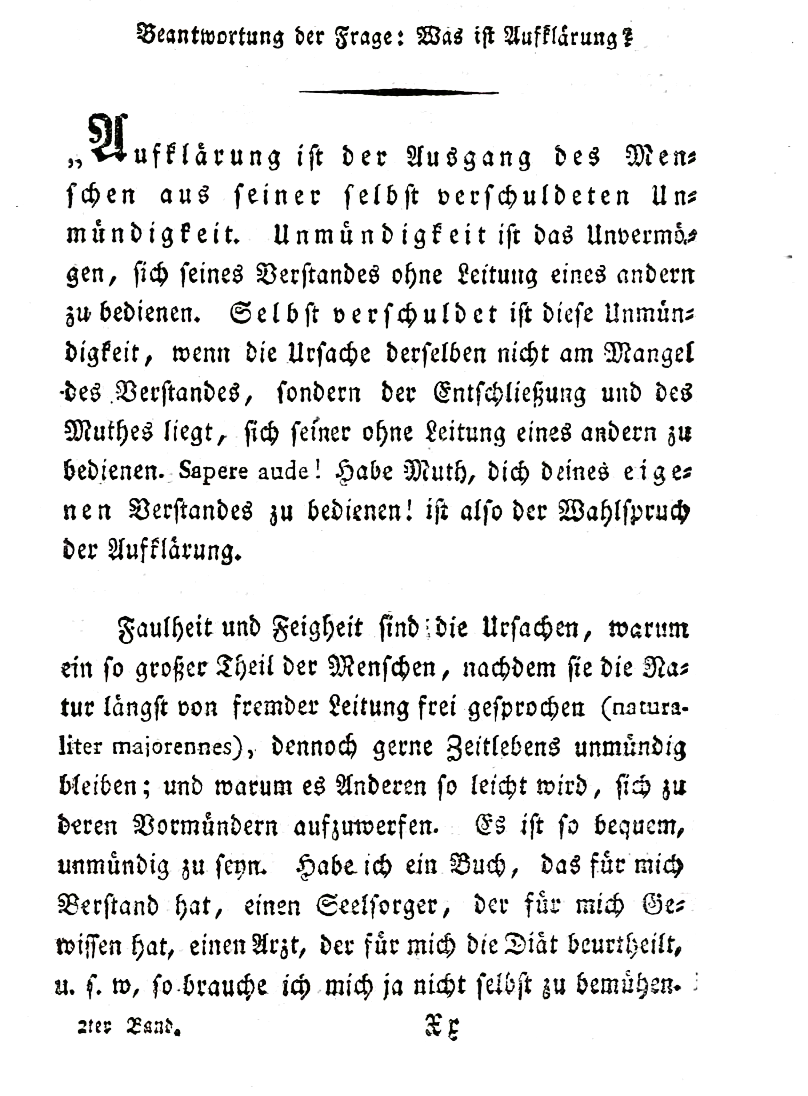
The message of the Enlightenment should be read and understood by all, even people working in the Academia (teachers and administrators alike).
Here is the original first page from Imanuel Kant's essay "Beantwortung der Frage: Was ist Aufklärung? -- Berlinische Monatsschrift, Bd. 4, 481-494, 1784".
26 April 2010
The second law of thermodynamics is against the Bible

Several years ago, the members of the Christian Coalition of America, headed by a certain Ralph Reed, stated:
"We don't like the implications of [the second law of Theormodynamics], and we will not rest until it has been reversed in the courts."This is the kind of idiocy requires no further comments.
"What do these scientists want us teaching our children? That the universe will continue to expand until it reaches eventual heat death? That's hardly an optimistic view of a world the Lord created for mankind. The American people are sending a strong message here: We don't like the implications of this law, and we will not rest until it has been reversed in the courts."
"Why can't disorder decrease over time instead of everything decaying? Is that too much to ask? This is our children's future we're talking about."
"My daughter's schoolbooks tell her that we live in a world ruled by disorder. That's a direct contradiction of what it says in the Bible, about how everything is going to get better, and we'll all live happily up in heaven after the End Times."
"This is America, and in this country, we have the God-given right to change laws we don't think are Christian. We are united in our demands that the second law of thermodynamics be repealed, and our voice will be heard no matter what. That's just a plain fact, and nothing anybody says can ever change it."
[Credit to a Nadder! ]
20 December 2009
Happy Newtonmas
30 November 2009
The white ribbon: a review
The 150 minutes long black&white film portrays a repressed society in a small German village just before the beginning of WWI. Although there is no central story, the film does not feel as long as it is because it manages to capture the spectators' attention who are seeking to comprehend every little detail in it. Even staring at the closed door, for what seems a long time, listening to childrens' screams, while they are being caned in a ritual punishment ordeal by their father (the priest), is not boring and makes you wonder. A society where almost nobody dares question the status quo be it patriarchical, feudal, religious, or sexual sadistic. Things are they way they are and must remain so, most villagers think. There is no escape from tyranny, work for the Baron is the only option available, and fun is only permitted when the Baron says so. One must feel guilty at all occasions: in school, at home, at work, in the church. Love, if it exists, is only in moderation and must not be seen or acknowledged.
Where are members of such a society led to? No wonder, they become torturers, killers, abusers, repressed individuals. Some of them have no choice because they have never been permitted to show their anger even as little kids. This anger grows and grows and, in the end, we know what happens: The little child will become the Nazi killer later on (no the film does not go there, but it clearly suggests so).
Yes, there are unresolved mysteries in the film, we wonder who did this hideous things, we start suspecting, and, in the end, perhaps we know. But this is not the point of the film. The film is not about trying to find the culprits as it has been suggested in many reviews. This is a secondary point, one that, if you wish, you can see in this way, but you'll be missing the central idea which is a bit more subtle. Or you can ponder on it later...
What I find most interesting in the film is not so much the direct punishment itself, but rather the implicit suppression of all kinds of things, including your thoughts, your opinions, your expressions... You are not allowed to even have a thought that may be different from the one imposed upon you by the feudal or religious establishment. If you do, you better hang yourself. There are, fortunately, survivors of this, and the narrator himself, the teacher of the village, is a rational person, one who will express what he feels and thinks. Fortunately for him, and for everybody else, deus ex machina in the form of WWI comes to provide a kind of cleansing: there is no other way for this society to heal itself other than be destroyed. Thus, the narrator, never has to go through the painful process of exposing his findings. He is saved.
The film is a psychological masterpiece. In it we can see all kinds of human emotions and acts: anger, revenge, love, repression, humiliation, pride, subordination, perversion, faith, exasperation, hope,.... We can take a look at what has happened, time and again, happens and will happen in human societies. And we can learn that, unless we question those out there who tell us how to think, when to laugh or cry, what to believe and how to behave, we will constribute, especially if this happens en masse, to our self-destruction.
Subscribe to:
Posts (Atom)
T H E B O T T O M L I N E
What measure theory is about
It's about counting, but when things get too large.
Put otherwise, it's about addition of positive numbers, but when these numbers are far too many.
The principle of dynamic programming
max_{x,y} [f(x) + g(x,y)] = max_x [f(x) + max_y g(x,y)]
The bottom line
Nuestras horas son minutos cuando esperamos saber y siglos cuando sabemos lo que se puede aprender.
(Our hours are minutes when we wait to learn and centuries when we know what is to be learnt.) --António Machado
Αγεωμέτρητος μηδείς εισίτω.
(Those who do not know geometry may not enter.) --Plato
Sapere Aude! Habe Muth, dich deines eigenen Verstandes zu bedienen!
(Dare to know! Have courage to use your own reason!) --Kant


